Saturday, September 12, 2009

Question To Those Who Know More Than Me: Wittgenstein and Latour


I'm reading Prince of Networks by Graham Harman right now. I'm still very early into it. He says this:

"It also ends the

tear-jerking modern rift between the thinking human subject and the un-

knowable outside world, since for Latour the isolated Kantian human is no

more and no less an actor than are windmills, sunflowers, propane tanks,

and Thailand."


Wittgenstein also seems to do this in a way. He purposes a public world where questions of an isolated human being just gives rise to problems which can be untangled by viewing a human being as inside a form of life. The objects a person uses and the way they interact with him are part of this form of life or language. Viewing everything language encircled whole, where the language games function and rules are followed, things seem to be in their proper place and act as they do without problem (a philosophical problem that is). The description of the Stalingrad encircling movement reminded me of LW's example of people bringing stones (I would consider the stones to be just a much part of the game). Yet I wonder if this is still too reductionistic for Latour, as it does in a way reduce the function of objects to their function in the language. Also LW always seemed to put humans in charge of setting up this game which may give them too much credit for Latour (though I'm not really sure as I may have interpreted him wrong and I may misunderstand Latour) To what extent do Wittgenstein and Latour overlap/ agree?


"Latour’s difference from present-day analytic and continental thought

should now be clear. Whereas Latour places all human, nonhuman, natu-

ral, and artificial objects on the same footing, the analytics and continentals

both still dither over how to bridge, ignore, deny, or explain away a single

gap between humans and world. While graduate students are usually drilled

in a stale dispute between correspondence and coherence theories of truth,

Latour locates truth in neither of these models, but in a series of translations

between actors."


I think my question also has relevance to this passage because LW could be seen as having a coherence theory of truth. I recall him saying that religion and mysticism play different games and are therefore true despite the completely different view of science. Though maybe that is stretching the word "coherence" and LW is beyond both with Latour.

LW could also be said to explain away the gap... but it seems more likely that he rejects any notion of a private space in the mind. Does Latour's series of translations (and by extension the notion of truth) exist in the public space, or is its location somewhere else?

Sunday, September 6, 2009

Reading List


This summer I finished Wittgenstein's Philosophical Investigations. I still haven't really come to terms with it in a way, so I think I might need another dose of him. But that will have to wait. Last year was all about Heidegger. This summer was all about Wittgenstein (and some Plato). So I'm going back into phenomenology now with Husserl's Phenomenology of Internal Time-Consciousness and a book about Phenomenology in general. If I get through those this semester what then?Maybe I'll finally actually read a book by Derrida. I read an essay by him that was in Writing and Difference and while not fully understanding it I got the point I thought. So maybe I'll read that one. My school appears to have a lot on Foucault also. But I'd rather get around to going back to reading Parallax View and In Defense of Lost Causes by Zizek. But recently I was reading Countermemory and he mentioned this thing called speculative realism. I did some research and this looks very interesting and very promising. But first Husserl.

Wednesday, September 2, 2009

Story!


Sorry I have not posted in a long time my followers. All zero of you. Here is a story I did for the INTP forum's writing brawl which didn't happen. Will post again soon when there is something to say. Researching Husserl right now. Note: The spacing is weird in blogger.

The Incorruptible

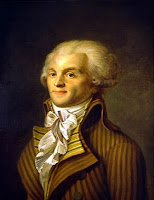
Maximilien stared up at the sky amid the trees in Arras. The little sunlight remaining illuminated only the edges of the trees. He had returned home soon after the constitution had been finalized. People lauded him and the rest of the Jacobins as the saviors of France, the founding fathers of a new republic. The terror was over. People were beginning to return to their normal lives. Sometimes there were still outbursts of violence but people were going back to work. But despite the adulation and congratulations the people had given him, Maximilien Robespierre still felt that things could have turned out better. In his opinion the terror should have never stopped. He knew that when he returned to Paris there would still be the enemies of the people amid his own colleagues. And he had allowed it.

Walking back down the grassy path he saw Charlotte standing in the doorway. Charlotte threw her arms around her brother. Maximilien lightly returned the embrace; he was in no mood for his over affectionate sister. The Robespierre household was cozy, not a large house, but nicely decorated with a fire going in the corner. His brother Augustine was still in Paris. How he longed to return. What was the future for the committee of public safety now that the constitution was in effect? He knew there were still enemies in Paris. His enemies and, by extension, enemies of the people and The Revolution were running the assembly. They said he was too bloodthirsty, they said he was a dictator. They even had the audacity to claim innocents had died. They only bothered stopping him when he was so close to exposing their corruption and having their heads cut off like they deserved. But then he had to face one question… why was he still alive?

He looked over those events that had lead up to the creation of the new constitution. He thought back to that night in the committee room. He had been looking over cases for the execution of a new batch of alleged counterrevolutionaries. Having supreme confidence in the local tribunal of that city he simply signed the off on the deaths. The men on the tribunal were like him, incorruptible, pure extensions of the people’s will. They could do no wrong as the people could do no wrong, as he could no wrong. The only other man in the room was Couthon. Couthon scooted his wheel chair over to Maximilien’s side of the desk.

“Don’t you think you should be a little more moderate in your use of the death sentence?” Couthon asked

Maximilien looked over at Couthon with surprise “What is this all of a sudden? You don’t trust the tribunals?”

“Listen, the tribunals make their charges at a drop of hat, taking the slightest deviation as proof positive of unpatriotic character. It is your job to make sure innocent people don’t die.”

“None of them are innocent if they gave evidence of their evil hearts.”

“Do you really believe that?”

“You don’t? I expected more from you.”

“This is why the assembly is turning against you. They say you are tyrant.”

“I am not a tyrant. It is the assembly that hides friends of tyrants.”

“If they hear of that, they will kill you.”

“Kill me?”

“Kill us.”

“Why? They should be glad I plan to liberate the assembly.”

“That is the point! You see enemies everywhere. They will fear they are next.”

“True patriots need not fear.”

“Is anyone besides you a true patriot?”

“Of course! There is you, Saint-Just, Hanriot, my brother, and millions of ordinary French citizens.”

“And if one of those citizens were to die in this terror?”

“They don’t.”

“They do. And you need to ease and lighten the terror. The new constitution is coming. After it’s drafted, people will want the terror to stop. When will it end?”

Maximilien remained silent. He remembered what he had once said as a rhetorical flourish to such a question before. It now struck him as all too true. “Never.” As he said this he took off his large glasses and slumped down in his chair.

“Excuse me? Did you just say ‘never’?”

“I’m tired Couthon. I’m so very tired. Maybe you are right. Maybe I’ll let the assembly have their constitution. Maybe lightening the terror is the next stage in The Revolution. I’ll live and France will grow.” He got up and began to go down the stairs “Good night Couthon.”

He kept his word but had Couthon killed for lack of patriotism. His head fell on the 10th of Thermidor.

As Maximilien reflected up in his study it dawned on him that he had had a moment of total weakness. He had done all the wrong things for the only thing that had meaning for him: The Revolution. Innocents had died, Couthon was one of them, and he had allowed it. And there were still enemies on the assembly; he had allowed them to live. He was as human, as corrupt as the rest of them. He had betrayed the Revolution. He got the revolver out of the drawer. “Liberty, Equality, Brotherhood. For the Fatherland and People of France. God forgive my sins. Amen.”

And he shot himself. Charlotte screamed.

Wednesday, February 25, 2009

Art?


I've been thinking about Art recently. I think one of the main distinctions that can be made is the pre-reflective and the post reflective methods. The pre-reflective may reveal something about the cultural and biological world of human beings. Post-reflective can also show worlds that may not be obvious, like in modern art for example. It would appear at first modern art has no obvious world that it references to. But is this not the point? Modern art references the picture plane, through this it points to the world of art itself as a work among works.

Sunday, February 8, 2009

Dream Analysis Part 3: Lacan

Okay for the final analysis I will be working with an interpretation that I am not as experienced with. A Lacanian analysis of my dream. The ordinary interpretation that I have developed so far is that the dream is reminding me of my situation with love. But this is looking at the dream's symbolic content which may be distracting from its real content. What my secret wish was, to make the right choice no matter what regarding love, under the Freudian interpretation is not really important. What is more important is the fact that it used school, tests, teachers, extroverted classmates, and symbols that link to art history and geek culture to fulfill this wish. The dream had to use this because the unconscious ideas needed a way to be articulated in the symbolic order which makes them morally okay. The imagery of school is deemed as fine. All these things are removed from the world of dating and romance. This shows what exactly my unconscious thinks is okay, what can be allowed. School, girls I would never date, geek culture, and anime comics about romance are all fine for me. It betrayed itself most in the comic though and that is why the both the Freudian and Jungian analysis was able to get as far as it did. What exactly is wrong with romance? Well it goes back to my grand conflict with the religion that I am raised with. Under this religion dating is something that people in the market for marriage. Dating would be a sign of my rejection, thus my death on judgement day. This is the dream's real meaning under Lacanian interpretation.

Well that's all, I learned alot. Dreams have more meaning than you may think especially if you remember them. 

Saturday, February 7, 2009

Dream Analysis Part 2: Jung

When undertaking a Jungian analysis then the question that must be asked: "What is the unconscious trying to tell me?" I must consider the dream's symbolism. So I'll start with the location: The school-  authority, learning, and social life. Sue and Jen- Humor, weirdness, and extroversion. Doctor- Knowledge, Religion, Buddhism, Christianity, Science, and Old Times. The weird symbol itself- The empire is a repressive regime with cool looking aesthetics, the rebel cause is about freedom however its a rather quaint bunch of heros (rather traditional, American made), the symbol seems ancient as if I've seen it somewhere before, looks somewhat heart shaped. Tests: Hard, bad, failure, risk, work, systems in the political sense. I think the narrative of the cartoons has been explained (I can't remember anymore than that which I've written down) above all I associate it with Heather.
Maybe Doctor is a wise old man archetype? If so, then he is testing us for some reason. Testing me about love? Maybe this dream is simply making clear to me where I stand with love in my mind. I draw the symbol easily with all its associations. Love looks cool, seems dangerous, yet also carries with it a quaint normalcy which I don't like. The extroverts take a different view of it than me, un-understandable to me yet equally right in the eyes of wisdom. So I work well with the idea of love, yet when faced the actual narrative reality, seeing a reproduction of my real situation with others, of it I am powerless. And what Doctor tells further alerts me to this fact.

I think I got somewhere with that. Next and finally Lacan.