Showing posts with label Speculative Realism. Show all posts

Monday, September 21, 2009

Some Ideas on Objects


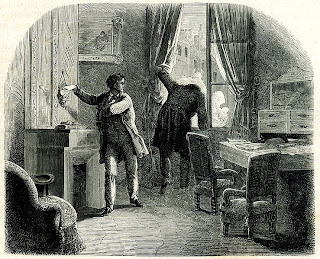
Harman mentions that Husserl is an object oriented idealist. Objects always are there as objects in consciousness for Husserl. Whatever their outside reality at least they could be called subjectively given. In Lacan's analysis of the Purloined Letter he makes note of the subjective drama going on in the two scenes where the letter is taken. Both the queen and the magistrate know where the letter is but she cannot take it back, she thought it was hidden. Dupin's action of taking back the letter also does this except it was never hidden it was just a different letter when the magistrate's back was turned. He also makes note of how the police looked for the letter everywhere but even though they looked everywhere they missed something in this everywhere because it was not in its place. They as subjects were situated in something. We could say the objects they were revealed subjectively as something but they lied. The subjects work to make the objects lie. In the queen's case the she failed and for Dupin it was a success. The objects are always our power enemies. We lay our hands on them and try to make them something, try to talk about them, but the want to be their ontic selves. This is why materialism is mentioned around speculative realism (my ignorance is showing, this is only my guess).

Onticicity is more than simply the subjective conception of being given to objects. It is not what makes them objects, it is their irreduceablity itself in relation to language and being. When they form an alliance with us they say "alright I will buy into this ontology of yours". And within that ontology their onticity remains as part of that ontology.

Does this make sense though if we regard objects as events though? I may have forgotten that.

Saturday, September 12, 2009

Question To Those Who Know More Than Me: Wittgenstein and Latour


I'm reading Prince of Networks by Graham Harman right now. I'm still very early into it. He says this:

"It also ends the

tear-jerking modern rift between the thinking human subject and the un-

knowable outside world, since for Latour the isolated Kantian human is no

more and no less an actor than are windmills, sunflowers, propane tanks,

and Thailand."


Wittgenstein also seems to do this in a way. He purposes a public world where questions of an isolated human being just gives rise to problems which can be untangled by viewing a human being as inside a form of life. The objects a person uses and the way they interact with him are part of this form of life or language. Viewing everything language encircled whole, where the language games function and rules are followed, things seem to be in their proper place and act as they do without problem (a philosophical problem that is). The description of the Stalingrad encircling movement reminded me of LW's example of people bringing stones (I would consider the stones to be just a much part of the game). Yet I wonder if this is still too reductionistic for Latour, as it does in a way reduce the function of objects to their function in the language. Also LW always seemed to put humans in charge of setting up this game which may give them too much credit for Latour (though I'm not really sure as I may have interpreted him wrong and I may misunderstand Latour) To what extent do Wittgenstein and Latour overlap/ agree?


"Latour’s difference from present-day analytic and continental thought

should now be clear. Whereas Latour places all human, nonhuman, natu-

ral, and artificial objects on the same footing, the analytics and continentals

both still dither over how to bridge, ignore, deny, or explain away a single

gap between humans and world. While graduate students are usually drilled

in a stale dispute between correspondence and coherence theories of truth,

Latour locates truth in neither of these models, but in a series of translations

between actors."


I think my question also has relevance to this passage because LW could be seen as having a coherence theory of truth. I recall him saying that religion and mysticism play different games and are therefore true despite the completely different view of science. Though maybe that is stretching the word "coherence" and LW is beyond both with Latour.

LW could also be said to explain away the gap... but it seems more likely that he rejects any notion of a private space in the mind. Does Latour's series of translations (and by extension the notion of truth) exist in the public space, or is its location somewhere else?

Sunday, September 6, 2009

Reading List


This summer I finished Wittgenstein's Philosophical Investigations. I still haven't really come to terms with it in a way, so I think I might need another dose of him. But that will have to wait. Last year was all about Heidegger. This summer was all about Wittgenstein (and some Plato). So I'm going back into phenomenology now with Husserl's Phenomenology of Internal Time-Consciousness and a book about Phenomenology in general. If I get through those this semester what then?Maybe I'll finally actually read a book by Derrida. I read an essay by him that was in Writing and Difference and while not fully understanding it I got the point I thought. So maybe I'll read that one. My school appears to have a lot on Foucault also. But I'd rather get around to going back to reading Parallax View and In Defense of Lost Causes by Zizek. But recently I was reading Countermemory and he mentioned this thing called speculative realism. I did some research and this looks very interesting and very promising. But first Husserl.